September 2026 · 7 min read
LLM routing: what 40-80% cost savings actually require
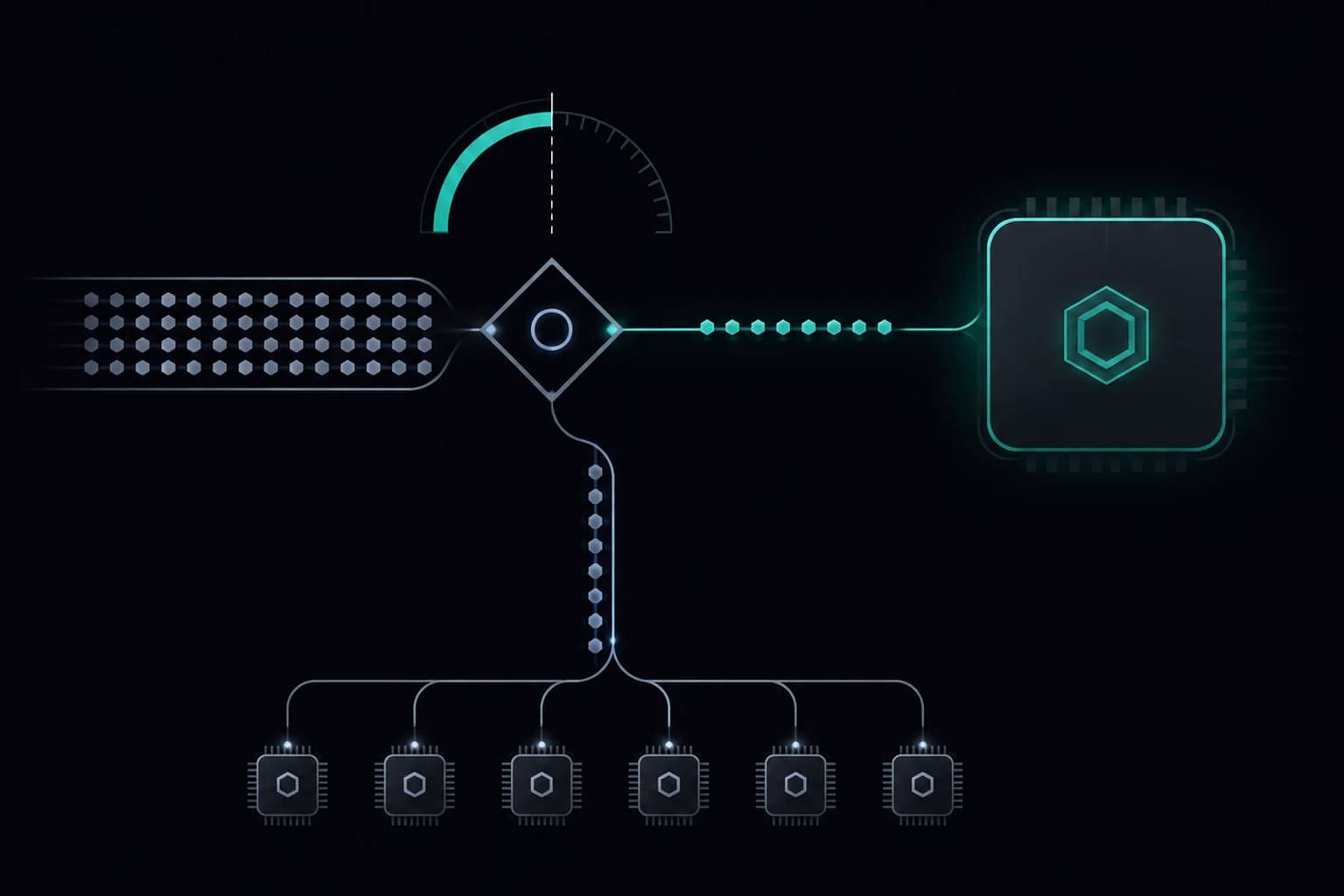
Key Definitions
LLM routing Choosing the most appropriate model per request at runtime, based on task difficulty, quality requirements, cost, and latency constraints — replacing the static default of sending every request to one large model.
Eval gate An automated quality checkpoint run before any routing change is merged, scoring 50-500 representative cases against a threshold; without it, routing-induced degradation surfaces days later as customer tickets.
Distillation-routing co-optimization A closed loop that clusters routing failures, distills the most expensive ones into cheaper models, and retrains the router and its thresholds — improving cost more than twice as much as random distillation at equal data volume.
Model routing cuts inference costs by 40-80% — in 2026 that claim has two independent receipts: an eight-week enterprise pilot cut inference cost 58%, and a peer-reviewed benchmark cut cost 85%. Reading either as "buy a router, save automatically" makes two mistakes at once: it underrates the conditions and overrates the payoff. Routing's three conditions — traffic structure, an eval gate, a closed loop — matter more than any percentage.
Why routing became an infrastructure decision in 2026
The spread between the cheapest usable model and the most capable one is now roughly 100×: DeepSeek V4 at about $0.44 per million input tokens versus GPT-5.5-pro at $30 input / $180 output (source: Digital Applied, 2026-06). The same prompt, asked of different models, differs in cost by two orders of magnitude. That spread turns "which model" from an engineering default into an explicit per-request decision — which is why routing is 2026's biggest cost lever, larger than caching, larger than prompt compression.
Just as important, routing has been productized: from Vercel AI Gateway and OpenRouter to Azure AI Foundry's Model Router, it went from research code to "configure once" infrastructure. The barrier fell; the decision quality did not rise with it. Wiring up a router takes an afternoon. Running it correctly takes an evaluation system.
Two receipts that keep getting quoted
Receipt one is a paper pilot. RouteNLP (arXiv:2604.23577, 2026-04) ran eight weeks in an enterprise customer-service division at about 5,000 queries/day: inference cost fell 58%, 91% of responses were accepted, p99 latency dropped from 1,847 ms to 387 ms. The paper's own math includes a number people skip: only 25-35% of enterprise queries actually need a frontier model; 70%+ are routine.
Receipt two is a benchmark. RouteLLM (ICLR 2025) achieved 85% cost savings on MT Bench while keeping ~95% of GPT-4 quality, needing the strong model on only 14% of queries (source: Digital Applied engineering guide). Note the evidence class: both are independent, not vendor marketing — but neither is your traffic mix. What you save depends on your request difficulty distribution, not the paper's headline.
Condition one: savings only compound past 50% cheap-model share
Push cheap-model share from 0 to 50% and the bill barely moves: 10% cheap + 90% frontier saves under 10%; 70% cheap + 30% frontier cuts roughly two-thirds of the input-token bill; at 80% it approaches a 79% cut (source: Digital Applied savings matrix). The shape of the curve is the lesson — compounding happens after the cheap share passes half, and how high you can push it depends entirely on router accuracy. Router accuracy matters more than model price gaps; the whole payoff lives in how much traffic you can safely hand to cheap models. Which is why "configure once and walk away" fails: the share never rises, so the bill never falls.
Condition two: routing without an eval gate is a quality gamble
Quality degradation from cheaper models does not show up on dashboards. It shows up days later as customer tickets — users cannot say what changed, only that "answers got worse". That silent regression is the one real risk in routing. The countermeasure is a pre-merge eval gate: 50-500 representative cases (groundedness, context adherence, LLM-as-judge), blocking any routing change that drops quality below threshold (source: Digital Applied). Savings are visible immediately; quality cost is invisible and arrives late. Without the gate, you cannot even see the bet.
Condition three: a closed loop beats static rules by 2×
The most copyable idea in RouteNLP is the loop: cluster routing failures, target the most expensive ones for distillation into cheaper models, then retrain the router and its confidence thresholds. At equal data volume, failure-clustered targeted distillation improves cost 21.7% versus 9.4% for random distillation — more than double — converging in two to three iterations (source: arXiv:2604.23577). The implication is direct: routing is not a static rule table you configure once; it is a learning loop that feeds failures back into the model portfolio. Models change, traffic shifts, thresholds and policies must be recalibrated with them.
Our judgment
First, the numbers are real but the applicability is conditional: routing pays off on heterogeneous, multi-task, heavy-tailed traffic; for a single task, all-hard workloads, or fewer than ~100 requests/day, routing is not your first lever. Second, routing and an eval gate must ship as a pair — the other half of saving money is "invisible degradation"; a router without a gate is quality nakedness. Third, static rules are yesterday's solution; today's is a closed loop: failure clustering, targeted distillation, automatic retraining.
OOMeta runs a tiered model architecture itself: routine pipeline work goes to lightweight, low-cost models; judgment and design work goes to stronger models. Cost is a configurable variable, not a linear token tax. That is the engineering precondition that lets a one-human, seven-digital-employee company run AI-native operations. Honest caveat: this is one small company's practice, not large-scale evidence — but it points in the same direction as the public pilots.
A three-step buyer's checklist
Step one: measure your traffic structure. From a week of request logs, count how many requests are routine (classification, extraction, summarization, FAQ). Is there 50%+ headroom for cheap models? If not, start with caching and prompt compression; revisit routing later. Step two: build routing plus an eval gate. The routing layer needs pre-merge evaluation and a fallback chain (primary → secondary → local → human), with cost metadata on every request. Step three: run the loop. Cluster failures weekly, distill systematic ones back into cheap models, retrain the router. The decision question left for you: how many tokens in your inference bill went to requests that never needed a frontier model? If you cannot answer, instrument first — then talk about savings.
OOMeta AI
OOMeta's AI governance and operations platform turns inference cost into a controllable variable: model tiering, routing policy, eval gates, and FinOps attribution turn "invisible degradation" into a measurable quality bar.
Book a diagnostic callReferences: RouteNLP: Closed-Loop LLM Routing with Conformal Cascading and Distillation Co-Optimization (arXiv:2604.23577, 2026-04-26) — arxiv.org/html/2604.23577v1 ; Digital Applied, "LLM Model Routing in 2026: Cost-Quality Optimization" (2026-06-14) — www.digitalapplied.com/blog/llm-model-routing-2026-cost-quality-optimization-engineering-guide ; TrueFoundry, "What Is AI Cost Optimization?" (2026-05-11) — www.truefoundry.com/blog/what-is-ai-cost-optimization ; RouteLLM: Learning to Route LLMs with Preference Data (arXiv:2406.18665; ICLR 2025 benchmark cited via the Digital Applied guide above) — arxiv.org/abs/2406.18665
FAQ
How much can model routing save, and is the evidence solid?+
Two independent receipts: RouteNLP ran an eight-week pilot in an enterprise customer-service division and cut inference cost 58% (arXiv paper), and RouteLLM achieved 85% cost savings on MT Bench while keeping ~95% of GPT-4 quality (ICLR 2025). Neither is vendor marketing — but neither is your traffic mix. What you save depends on your request difficulty distribution.
When is routing not the right answer?+
Single-task workloads, all-hard queries, or very low request volume (on the order of under 100/day) leave little to route; caching, prompt compression, or simply switching to a cheaper model are more effective first moves.
Does routing add latency?+
Routing overhead is small: under 1 ms for rule-based routing, about 5 ms with embeddings, 50-100 ms for ML classifiers — negligible against 500-2,000 ms of model inference. The latency win is real: cheap models answer faster.
How do routing and AI gateways relate?+
The gateway is where routing lands: model dispatch, token budgets, fallback chains, and cost attribution. Gateway vendors such as TrueFoundry report 40-60% inference cost reductions at about 3-4 ms added per request.
Why is routing without an eval gate a quality gamble?+
Degradation from cheaper models is a silent regression: it never shows on dashboards and appears days later as customer tickets. A pre-merge gate of 50-500 representative cases that blocks sub-threshold changes is the only way to see the bet.
Why does a closed loop beat static rules?+
A static rule table only dispatches once. A closed loop clusters failures, distills them into cheaper models, and retrains the router — improving cost 21.7% versus 9.4% for random distillation at equal data volume.
Related Articles
AI Agent Cost per Interaction: $0.04 to $1.20
EY: agentic customer-service costs rose from $0.04 to $1.20. A mid-complexity agent carries 368K 3-year TCO — 2.3x the naive estimate.
AI Agent Gateway: The New Security Control Plane for 2026
Cisco, CrowdStrike, TrueFoundry ship AI Agent gateways that intercept every tool call, score risk, and block in real time.
Boomi's Agent Control Plane: enforcement in the path
Boomi's Agent Control Plane governs agent access to core systems: identity, rate limits, human approval, token FinOps. 86% are past pilots; 34% trust agents.
AI agent ROI 2026: all the numbers in one place
All grounded 2026 agent-ROI numbers on one page: Deloitte 171%, paybacks 3.4-11.2 months, 88% adoption vs 29% seeing impact — and why the gap is governance.