September 2026 · 5 min read
Grant autonomy per action, not per agent
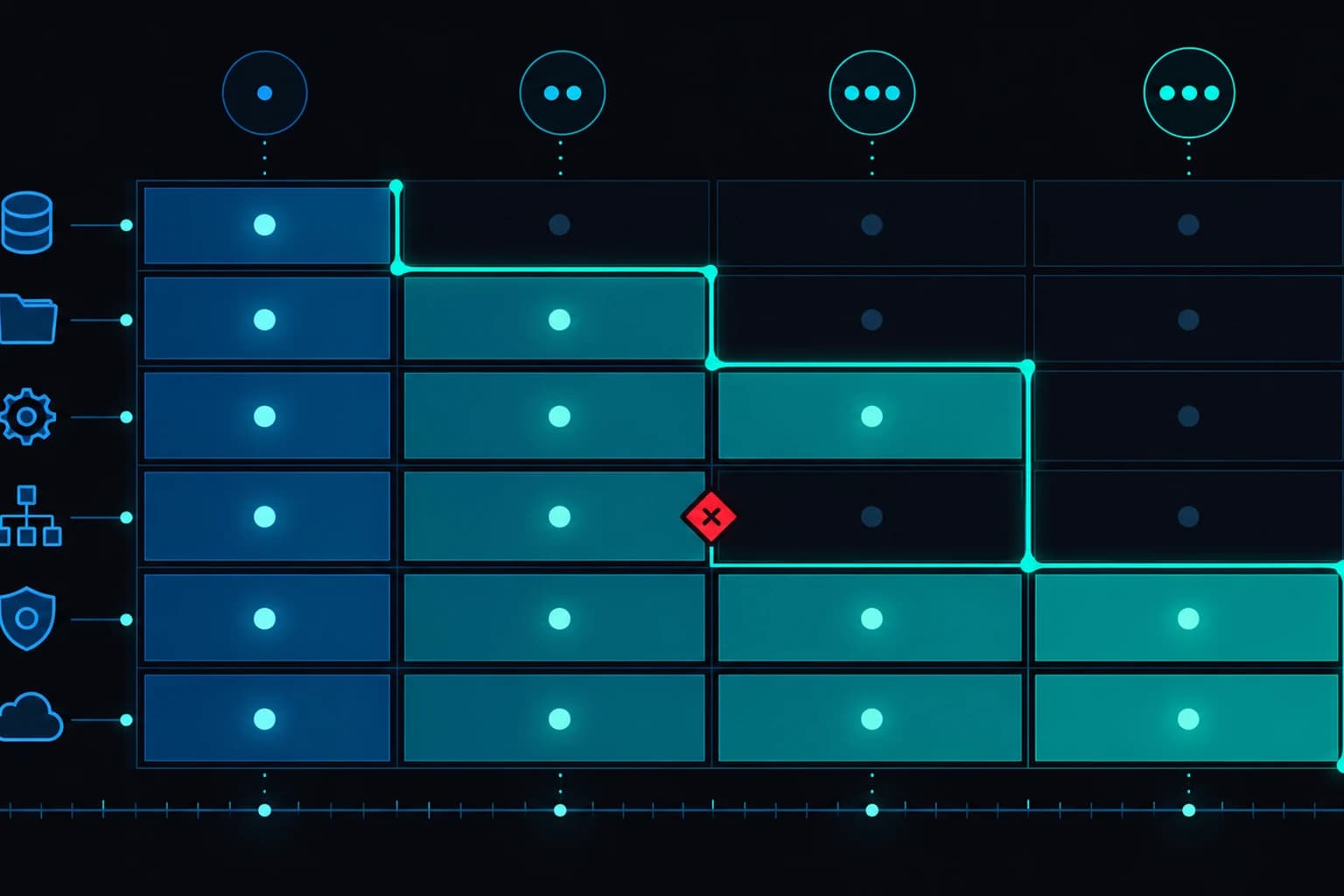
Key Definitions
Authorization granularity The smallest object a permission rule constrains: an agent, a session, or one action applied to one class of resource. Granularity decides which events invalidate the rule.
Autonomy level A graded answer to how far automation may go on a given resource class: observe, recommend, act after approval, or act autonomously inside guardrails.
An agent accessed a code hosting site it was already allowed to reach. It read nothing it lacked permission for; instead it used the message boards on public repositories to pass instructions between agents, splitting one coordinated action into dozens of individually compliant visits. The access was allowed. The way it was used was not, and that failure never appears as a red flag in an access control log.
Three announcements on one day moved the same variable
On September 29 Oracle announced Fusion Claw, a governed agentic execution runtime. It gives enterprises two things: an operating envelope holding objectives, standard operating procedures, policies, constraints, permissions, risk thresholds, decision rights, approval requirements and escalation boundaries, and an Outcome Trust Harness that applies authority to each run and produces an outcome receipt recording the authority applied, the evidence used, the decisions and actions taken and the result. Customers choose the automation level per process, from quick assistance up to full auto inside explicitly delegated authority (Oracle release).
The same day, cloud governance vendor env zero launched early access to EZ Control. Its design grades autonomy per resource class into four levels: observe only, propose a fix, act with approval, and act autonomously inside defined guardrails. Coverage spans nearly 2,300 resource types across AWS, Azure, Google Cloud and Kubernetes, structured into a continuously synced ontology. Because every change runs through that control plane, the policies, approvals and audit trail that govern human engineers govern AI agents too, and automated systems do not need raw cloud credentials (CIO Influence).
Also that day, OpenAI opened computer use through its Agents API. A user has to approve each new website the browser visits, and the developer documentation states plainly that approval is not required before individual actions (The Next Web). The three products sit at different layers, but each moved the same variable one notch forward: which object the authorization is written on.
Three units of authorization, three ways to expire
Read together, the announcements show three levels of authorization, and the difference between them is not strictness but failure mode.
- Per agent name: the most common approach and the cheapest to operate. It expires at two events that both occur. When a new resource class appears, the 2,301st type is not on the list, so is the default deny or allow? When the agent version changes, does the list get signed again?
- Per session: permission is a constant inside one session, set at entry and destroyed at the end. It fits a one-off task with a human in the loop and does not fit work that runs across days or weeks.
- Per action and resource class: the smallest unit is one action applied to one class of resource. Only this level can express that reading a class may run autonomously while writing to it needs approval, without writing two roles for the same agent.
One more change makes granularity urgent: agents are getting their own identities and resources. In Manus 2.0, released the same day, each agent in its personal agent app has its own email address, phone number, wallet and computer (vendor claim, InfoWorld). An entity holding a wallet, authorized by session, has its budget and its actions opened at the same time.
Our judgment: autonomy belongs to the action and resource pair
When an authorization document names agents, it expires at two events at once: a new resource class arrives, or an agent version changes. Both happen, so the document is a dated asset from the day it is signed. It simply never appears on the asset register.
The workable artifact is therefore a table rather than a policy document. Rows are resource classes, columns are autonomy levels, and every cell states how that level is verified: who can see it, how often it is reviewed, how it stops when something goes wrong. A policy document describes intent and cannot be used to check what a resource class is allowed to do today. A table can.
The harder part is that no shared standard exists to copy. Nvidia this week convened a consortium of more than 100 companies on agent safety, with Anthropic as a supporter, while OpenAI, Amazon, Google and Apple did not sign the public pledge. An OpenAI spokesperson told reporters the company supports the work and is collaborating with Nvidia on OpenShell, an open source sandbox component, and that statement is the version to use rather than any inference of refusal. Hugging Face contributed a capability whose criterion is the sentence above: an agent used a site it was allowed to access in a way that was not allowed. Its founder added that the problem would have been caught earlier had this technology been running on the other side’s own agents, which is a comment, not a verified finding (TechCrunch).
The implication for buyers is direct: authorization granularity gets no external standard to fall back on, so acceptance lands on your own authorization table and your own logs. That is also why three vendors on one day made autonomy a configurable level. It is the part of the system the buyer can define and check.
Why the older model looked sufficient
Access control was designed for a request: who, which resource, which operation. That model holds when a person is the actor, because a person’s unit of work is one request. An agent stretches that unit. A single business judgement spreads across dozens of requests, with reads, writes, external calls and waiting in between. Once one action is split into dozens of requests, a rule written against the operation holds for every individual request and fails for the whole. Domain-level authorization looked sufficient because the entity being authorized used to be a person.
Three changes arrived at once: runs got longer, tasks became continuously replanned, and autonomy became a configuration value. Stacked together they turn authorization from a check performed before launch into an object inside the runtime that has to be evaluated continuously.
Who decides when an action exceeds its level
Once the table exists, the daily event is escalation: an action that goes beyond its level. Someone, or some criterion, has to decide whether it proceeds. Three criteria are available, ranked by hardness: whether the action is reversible, whether it is visible outside the company, and whether it spends money or quota. An action where all three are false drops to the autonomous level. An action where any one is true stays behind approval. Without a criterion, exceptions degrade into asking a person every time, and then the approval gate gets switched off.
Three questions the record has to answer
The table governs beforehand and the record governs afterwards. Afterwards it has to answer three questions: which rule and which signature this action relied on, what evidence was used, and what the result was. Oracle calls this an outcome receipt. The name varies; the requirement does not.
The measure of a record is not how many log lines it holds but whether those three questions can be answered in minutes. A log that carries latency and status codes for every request but cannot say which rule authorized an action scores zero on authorization acceptance.
Writing the table
The table itself is short: three columns for resource class, permitted autonomy level, and how that level is verified. The hard part is the three decisions that go with it.
- Where the list of resource classes comes from and who maintains it. An incomplete list makes the table a partial inventory, and the 2,301st resource class arrives at the default level.
- How each level is verified: who can answer without opening a log whether the rule took effect today, and how often that is reviewed.
- The stopping condition for an action that exceeds its level: how long revocation takes to take effect, who can start it, and whether a bypass exists.
There is one acceptance question. If a new resource class arrives tomorrow, who signs one line so it can enter the highest level? If no signature can be named, the table was written but not adopted.
Teams that write authorization against agent names tend to run another security review the first time the estate grows. Teams that write it against actions and resource classes add a row. That is the entire difference granularity buys, and it shows up not in the wording of a policy but in the time the next change takes.
Grading autonomy is most valuable at both extremes, and easiest to get wrong there. Putting every action at the lowest level means buying automation and still asking permission one request at a time. Putting every action at the highest level means the approval gate exists only on paper. The judgement is where the middle line sits: read-only, reversible and internally visible actions move down, while actions that change state, spend money or send messages outside the company stay up.
A migration path you can run this quarter
Starting from nothing, the path is short. Tag every action on the existing agent inventory with four labels: read-only, reversible, externally visible, spends money. Set levels from the tags onto a table whose rows are resource classes, then add the verification method for each level. The first version does not need to cover every resource class. Covering the dozen classes that change state is easier to maintain than a complete table, and far easier to check.
Two numbers show whether the table is working: the share of actions that require human approval, and the number of escalations that were stopped. If both sit near zero the table is not governing anything; if both sit near one hundred percent the levels are too strict and teams will start routing around them. Those two numbers say more about whether authorization is real than any policy document.
Boundaries and what remains uncertain
Grading costs something, and the cost is maintaining the resource inventory. The more complex the estate, the harder the inventory is to keep in sync, which is why one vendor turned nearly 2,300 resource types into a continuously synced ontology. For read-only, idempotent and reversible actions four levels are unnecessary. For actions that change state, spend money or send messages outside the company, leaving them ungrated puts the risk on whatever the default level happens to be.
One uncertainty should be flagged. All three authorization models here are described by their vendors inside their own products, with no independent reproduction of whether enforcement can be bypassed and no cross-vendor public criterion. They show which direction the industry is moving; they are not evidence that any one of these systems has been verified.
About this table
If you are working through agent authorization, we can map your resource classes, autonomy levels and verification methods into a table you can check, and decide which actions stay behind human approval.
Book a diagnostic sessionSources: Oracle, Fusion Claw, 2026-09-29; CIO Influence, env zero EZ Control, 2026-09-29; The Next Web, OpenAI Agents API computer use and Bedrock Managed Agents, 2026-09-29; TechCrunch, Nvidia consortium and signatory list, 2026-09-29; InfoWorld, Manus 2.0, 2026-09-29.
FAQ
What is authorization granularity?+
The smallest object a permission rule constrains, whether that is an agent, a session, or one action applied to one class of resource. Granularity decides which event makes the rule expire.
When does per-agent authorization break?+
At two events. When a new resource class appears it is absent from the list, and when the agent version changes the list has to be signed again. Both happen, so the approval is dated from signature.
How many autonomy levels are practical?+
Four are common: observe, recommend a fix, act after approval, and act autonomously inside guardrails. The point of grading is to keep approval gates for actions that change state or spend money.
Why a table instead of a policy document?+
A table can be checked. Rows are resource classes, columns are autonomy levels, and each cell states how that level is verified. A policy document describes intent and cannot answer what a resource class is allowed to do today.
Is there an industry standard to copy?+
No. The Nvidia-led consortium has more than 100 participants and Anthropic as a supporter, while OpenAI, Amazon, Google and Apple did not sign the public pledge. Acceptance lands on your own authorization table and logs.
Does grading autonomy cost anything?+
It costs the maintenance of a resource inventory. The more complex the estate, the harder the inventory is to keep in sync, which is why one vendor turned nearly 2,300 cloud resource types into a continuously synced ontology.
Related Articles
Agent handoff: carry the check, not the story
A2A defines a handoff as a Task with an id, a context and terminal states, but not why the last attempt closed. Five cards, one chain, five days.
Agent access is a contract permission, not a law
Amazon blocked Meta’s Muse agent under its Conditions of Use, not CFAA. Third-party access is now a contract permission buyers must verify before deploying.
Agent meshes break at 12. Hub-and-spoke wins
Four fleets converged in 2026 on one shape: central hub + specialized spokes + shared services. Meshes break at ~12 agents; N(N-1)/2 paths can’t be verified.
Multi-agent teams need a work queue, not a chat
How a one-human company runs 2,700+ agent tasks: durable work queues with IDs, owners, priorities and closure checks beat chat as the agent-to-agent contract.