September 2026 · 7 min read
Customer service AI: volume to machines, value to humans
Key Definitions
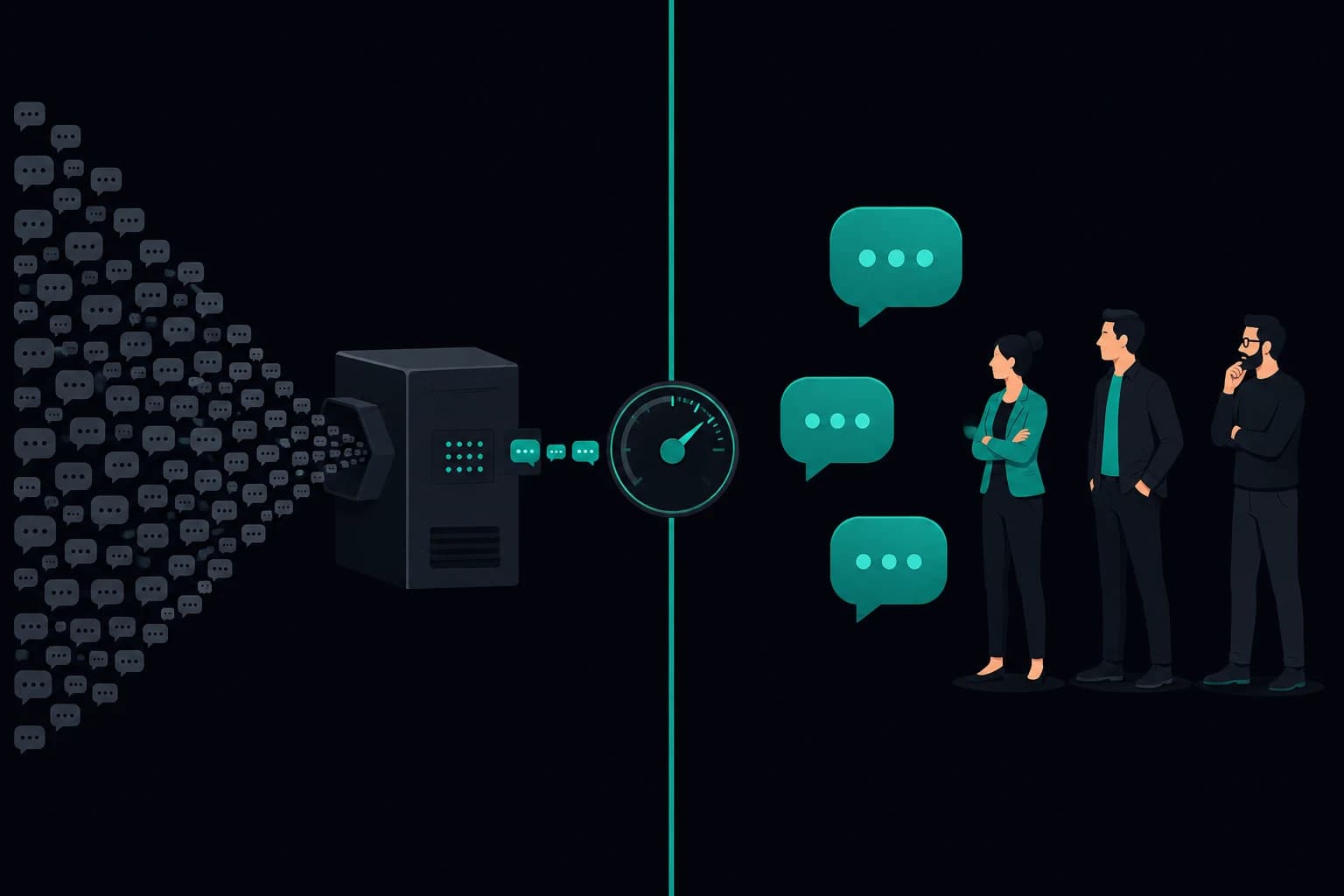
Volume tier / value tier A two-way split of customer-service conversations — the volume tier is high-frequency, low-complexity, authenticated conversations (order status, address changes, returns) that AI can absorb wholesale; the value tier is complex, high-emotion, or high-stakes conversations that need human judgment and empathy.
True resolution Kogan.com's self-built service metric: the share of inquiries fully answered with no follow-up contact. Unlike deflection, it measures customer experience rather than cost.
Deflection rate The share of requests handled by AI without human escalation; essentially a cost metric that customers never experience.
"AI replaces customer service" was the 2024 frame. The 2026 evidence rewrites it into a much more precise design problem: volume tier to machines, value tier to humans, and a boundary that can be designed, measured, and recalibrated. The first wave (Klarna) proved how much machines can absorb. The second wave (Kogan.com, BILL, Engine) proves something else — that the metric you choose and where the freed capacity goes decide whether this is cost savings or value creation.
Wave one: Klarna showed the volume tier is absorbable
Klarna's AI assistant went global in February 2024: 2.3 million conversations in its first month — workload equivalent to roughly 700 full-time agents; average resolution dropped from 11 minutes to under 2; repeat contacts fell 25%; the company projected a $40M profit improvement in 2024 (all Klarna-reported figures: investor materials and official announcement; analysis via Perspective AI). These numbers got quoted everywhere and misread everywhere — they are workload-equivalence math, not a layoff count.
The real turning point came in May 2025, when CEO Sebastian Siemiatkowski publicly admitted the company had cut too deep on humans and reopened hiring for premium support roles (Bloomberg). Note what happened: AI did not leave Klarna — it remains the front line of the high-volume tier; what got recalibrated was the boundary, with complex, high-value conversations going back to humans. That is not a failure case for customer-service AI. It is a public sample of boundary calibration.
Wave two: Kogan.com calibrates with "true resolution"
At Australian pure-play retailer Kogan.com, roughly 60% of inbound requests are routine "where's my order" questions. It started with one use case — order management — then added returns, product recommendations, and TV troubleshooting (Salesforce blog, 2026-07). Instead of the industry-standard deflection rate, it built a stricter metric of its own: true resolution — the share of inquiries fully answered with no follow-up contact. The number is validated monthly against Salesforce's own count. At launch in March 2026 it was 6.2%; today it stands at about 20% — progress earned through A/B testing every release, deterministic flows for complex cases, and continuous tuning on real transcript data.
The results are checkable: the agent handles roughly 50% of inbound requests; customer preference for the agent rose from 50% to 78%; CSAT for agent-handled interactions sits within 4 points of human-handled ones; over the past year Kogan absorbed 20% more sales volume with a 10% drop in servicing costs (co-reported by Salesforce and Kogan; unaudited).
Scale and regulation: BILL's 70% and Engine's 50%
BILL, the US fintech serving 500,000 SMBs with ~1.4M support queries a year, set AI a hard target: at least 30% deflection, with a credible path to 60%. A POC on 200,000 real queries came back at 70% AI resolution; full deployment landed in 15 weeks; savings exceed $5M while customer satisfaction held or improved (DevRev customer case, republished by a CX outlet; vendor/customer-reported). A regulated financial workload reaches 70% because of Salesforce workflow integration and compliance guardrails — not because the model is smarter, but because the boundary and escalation path are clearer.
Engine, a B2B travel platform, is the other sample: its AI agent Eva auto-resolves 50% of chat inquiries, cuts support handle time 15%, and lifts CSAT 16% (Salesforce customer story, 2026-06). The common thread: the volume tier's preconditions are authenticated context (knowing who is asking), a bounded intent set, and an explicit escalation path. Miss any one of the three and deflection becomes complaint.
From cost to revenue: where does the freed capacity go?
Salesforce's own path is the clearest illustration. Act one: Agentforce handled 3 million support conversations; support caseload fell 8% YoY (170,000+ fewer cases); annualized savings reached $100M (Fortune, 2026-04; Salesforce-reported). Act two: it pointed agents at dormant leads — a long tail of low-priority prospects humans had written off as uneconomical. Result: 3,200+ opportunities influenced, and business closed that would otherwise have stayed invisible (same source). Same capability, phase one cuts cost, phase two creates revenue.
That confirms a judgment: a customer-service AI ROI formula is incomplete until you write down where the freed capacity goes. Projects that only count cost savings are still playing in the 2024 frame; teams that redeploy the saved time into retention, up-market work, and dormant leads are the ones entering act two.
Our judgment
First, deflection rate is a cost metric; true resolution is a customer metric. What you measure is what the team optimizes; a team chasing only deflection will quietly push complex cases at the AI and watch repeat-contact rates rise. Second, the volume tier works only with "authenticated context + bounded intents + escalation path" — all three. Klarna worked because of structured data, authenticated users, and a finite set of common intents; porting that playbook to complex B2B support is a category error. Third, the boundary is not drawn once; it is continuously recalibrated. Klarna's 2025 correction and Kogan's monthly true-resolution audits are calibration moves, not failure signals.
A test for buyers: list your top five high-frequency conversation types and score each with an "AI completion" rating (0-100). Give 80+ to machines, keep 50- below with humans, and explicitly design escalation for the middle band. That is the starting point of boundary design, not the end.
Action checklist
Three steps. First, switch the metric — replace deflection rate with true resolution (or first-contact resolution) so the team optimizes customer experience, not cost. Second, draw the boundary — high-frequency, low-complexity, authenticated conversations go to AI; complex and high-emotion ones stay with humans; design escalation for the middle. Third, redeploy the capacity — put the saved time into retention, up-market work, and dormant leads. That is where act two's ROI lives.
OOMeta AI
OOMeta's AI governance platform helps enterprises build agent inventories, runtime monitoring, and policy enforcement — turning customer-service AI boundaries and escalation paths into executable real-time controls.
Book a diagnostic callReferences: Salesforce blog, "How Kogan.com Automated 67% of Customer Inquiries and Tripled Resolution" (2026-07-10) — www.salesforce.com/blog/kogan-agentforce/ ; Salesforce customer story, "Engine resolves 50% of chat requests with agentic service" (2026-06-04) — www.salesforce.com/customer-stories/engine/agentic-service/ ; Customer Experience Live, "BILL transforms with DevRev's AI platform, saving $5M" (republishing DevRev's customer case) — www.customer-experience.live/post/bill-transforms-with-devrev-s-ai-platform-saving-5m-while-improving-customer-experience ; Fortune, "AI's next act: how Salesforce is turning efficiency gains into revenue" (2026-04-18) — fortune.com/2026/04/18/salesforce-agentforce-ai-efficiency-revenue-growth/ ; Perspective AI, "Klarna AI Customer Service: Replacing 700 Agents — A 2026 Case Study" — getperspective.ai/blog/klarna-ai-customer-service-replacing-700-agents-conversational-ai-case-study ; Klarna press release, "Klarna AI assistant handles two-thirds of customer service chats in its first month" — www.klarna.com/international/press/klarna-ai-assistant-handles-two-thirds-of-customer-service-chats-in-its-first-month/ ; Bloomberg, "Klarna Turns From AI to Real Person as Cost Cuts Go Too Far" (2025-05-08; cited via Perspective AI) — www.bloomberg.com/news/articles/2025-05-08/klarna-turns-from-ai-to-real-person-as-cost-cuts-go-too-far
FAQ
Does Klarna's correction mean customer-service AI failed?+
No. AI remains the front line of Klarna's high-volume tier; what got recalibrated is the boundary, with complex and high-value conversations returning to humans. That is a public sample of boundary calibration, not a directional retreat.
What is the difference between deflection and true resolution, and why switch?+
Deflection is a cost metric (how much AI intercepted) that customers never feel; true resolution is a customer metric (was the issue fully resolved with no follow-up). What you measure is what the team optimizes.
Which conversations are right for AI?+
High-frequency, low-complexity, authenticated ones: order status, address changes, returns, FAQs. Three preconditions: authenticated context, a bounded intent set, and an explicit escalation path.
Can these ROI numbers be trusted?+
They are all co-reported by vendor and customer, unaudited: Klarna's 2.3M conversations and 700-agent workload equivalence, Kogan's 50% of requests and ~20% true resolution, BILL's 70% resolution and $5M savings. Useful for modeling, not for contractual commitments.
Where should the freed capacity go?+
Into the value tier: retention, up-market work, dormant-lead activation. Salesforce's own act two shows the same capability moving from cost savings to revenue (3,200+ opportunities influenced).
How should the boundary be designed?+
Score your top five high-frequency conversation types on an 'AI completion' scale (0-100): give 80+ to machines, keep 50- below with humans, explicitly design escalation for the middle band — then keep recalibrating with real data.
Related Articles
Citi's Arc: the largest measured agent deployment
Citi's Arc runs agents as a central OS: 180k staff, 40k devs on Devin, 100k+ agentic hours weekly, legacy migration from 12 months to 4 weeks.
Genesys launches AI Control Plane for agentic CX
Genesys' AI Control Plane coordinates AI, humans and systems around one governed customer journey. Cloud ARR nears $2.9B, AI ARR tops $400M.
Experian Agent OS: risk decisioning for enterprise workflows
Experian's Agent OS exposes risk, identity and decisioning as enterprise agents; ServiceNow is the first partner. Regulated decisions stay human-in-the-loop.
AI Agent Orchestration: Build vs Buy Decision Framework 2026
Multi-agent systems hit production. Gartner: 50% of vendors see orchestration as key differentiator. Enterprises face critical build-vs-buy decisions.